Flanders in the 19th century

At the start of the 19th century, a great many Congregations were founded by parish priests who wanted to gather together a few devout young ladies under the patronage of St Vincent de Paul in order to dispense charity in their parish: assisting the poor and the sick, and teaching working-class children. Rules of life were eagerly copied and provided with some personal devotional practices of the respective founders according to their preference and knowledge.
The founder Petrus Joseph Triest
Peter Joseph Triest was one such parish priests, namely at Lovendegem near Ghent. He established the Congregation of the Sisters of Jesus and Mary "to organise education in honour of God" after the French Revolution. His organisational talent and special sensitivity to the poor and the less privileged must have impressed both the civil and the ecclesiastical authorities of Ghent. They called him and his Sisters to the city in 1805 in order to take care of incurable patients at the "little convent of charity" at the former Ter Haeghen Abbey.
Thereafter, things gained momentum: on 1 July 1807, Fr. Triest, recently made honourable Canon of St Bavon's, became member of the "Committee of Order and Economy". On 11 July he was appointed as director of the civil hospital of the Byloke. In October, he became a member of the "Commission of Civil Hospices," and on 12 December director of the "twelve small hospices." The year 1807 was decisive for the Brothers of Charity. That Congregation was founded on 28 December. Its purpose was to take care of the elderly men at the Byloke Hospital.
Foundation and General Evolution of the Brothers of Charity
The Byloke Hospital accommodated patients who were looked after by Cistercian Sisters and elderly people. Theodore Caluwaert, and Fr Férin after him, was in charge of the male section. When Triest took over as director at the Byloke nobody was actually in charge of the aged men and disorder reigned. In order to put an end to the chaos, Triest submitted a plan to the Commission to recruit and train five virtuous young men who could then take over the men's section. They would form a community under the protection and supervision of the Commission in whose service they would be. The elderly had to call these young men "Brother" and consider them as their benefactors and friends.
On 28 December 1807, Canon Triest brought three young men to the Byloke; a few days later, they were joined by two more one of whom was Anthony Blaton, who became the first superior and bursar. These Hospital Brothers of St Vincent succeeded in restoring order among the aged. By the end of 1808, there were 13 Brothers. At the commission's request, Triest sent six Brothers to the Alexian monastery to take care of the prisoners and the mental patients there. But the rather inexperienced young men were not up to their task: four of them threw in the towel and the other two returned to the Byloke by the end of 1808. When both of them passed away shortly thereafter, discouragement set in among the Brothers so that only two Brothers, nearly desperate, were left by mid-1809.
At the end of July 1809, Canon Triest thought that he "had caught an angel by the legs" in the person of Joseph Truyens. The bishop of Ghent encouraged Triest to apply for Episcopal approbation of the Brothers as a religious congregation. Triest compiled a religious rule of life consisting of 30 articles. It was recognised as the Rules for the Brothers of St Vincent on 23 November 1809. The congregation prospered only for a short while. For after some time Joseph Truyens disappeared with the cash. But Triest did not despair and started all over again with the 61-year old Simon John de Noter as leader of the group of Brothers. On 21 November 1810, Bro. Bernard de Noter and his five companions took the religious habit and started their noviciate.
Triest's concern about making real religious of his Brothers was fully shared by Bro. Bernard. The latter gradually introduced religious customs in the Brothers' lifestyle, like the recitation of the Office of Our Lady. The Brothers of Charity, as they had become popularly known, took their first vows on 26 November 1811. Father Bernard was elected as the Brothers' superior. After four years of setbacks, the difficult beginning was finally crowned with success.
The care for the mentally ill
In 1815 a new enterprise was started, i.e. the care of the mentally ill in the crypt of Gerard the Devil's Castle in Ghent. Meanwhile Brother Macharius alias Jan Bertyn, the gatekeeper, had started to teach some neighbourhood urchins at the Byloke. At the nearby paterhuys the Brothers had started looking after incurable patients in 1814. In 1820, the Congregation started expanding its activities outside the diocese of Ghent and established an asylum for mentally ill in Froidmont, The Maison forte. In 1822, a charity school was started in Bruges. A school for the deaf was opened in Ghent in 1825. In an odd decade, Triest and his Brothers had set up several charitable works which they would further develop: care of the elderly, the mentally ill, the disabled, and mainstream education. Thus the Brothers were launched to become more than just a local Congregation: they spread the message of effective charity all over the world.
However, they were not spared by their opponents: King William I, who pursued an anti-Catholic policy, forced them to stop accepting candidates to the brotherhood for some time and to withdraw from a primary school in Roborst, an orphanage in St.-Niklaas and the Byloke School. It was not until 1830 that the right to associate was guaranteed by the Belgian Constitution so that official recognition could be obtained. The Byloke School was reopened immediately. New schools were founded in Antwerp and Louvain (1832), St.-Truiden (&833), Ostend (1837). A school for the deaf was established in Brussels in 1835, and an orphanage was opened in Ghent in 1833.
In 1832, Father Bernard died. Father Aloysius succeeded him at the head of the Congregation and he would remain in that function till 1871, except from 1862 till 1865 when Father Gregory was general superior. He set the Congregation back on the right track. Till 1832, the Brothers had always left the management of their works in the hands of outsiders, but this caused trouble increasingly. Therefore, they built their own asylum for mental patients in St.-Truiden in 1863, and another one in Zelzate in 1864. A main step forward was the sending of some Brothers to Canada in 1865 in order to cater for an orphanage and an old-age home.
From 1871 to 1922
After Father Nicolas's short period of government (1871-1876), the Congregation was headed by Father Amedeus Stockmans, who would remain general superior till his death in 1922. His government was marked by an enormous growth in the number of Brothers and houses, as well as by the apostolic approbation of the Congregation in 1899. In 1876 the number of Brothers was at 274 but it reached 1,062 in 1922; 26 houses were founded in Belgium, 17 abroad. The papal approbation helped the expansion abroad.
Branches in the four corners of the world and the Superior Generals.
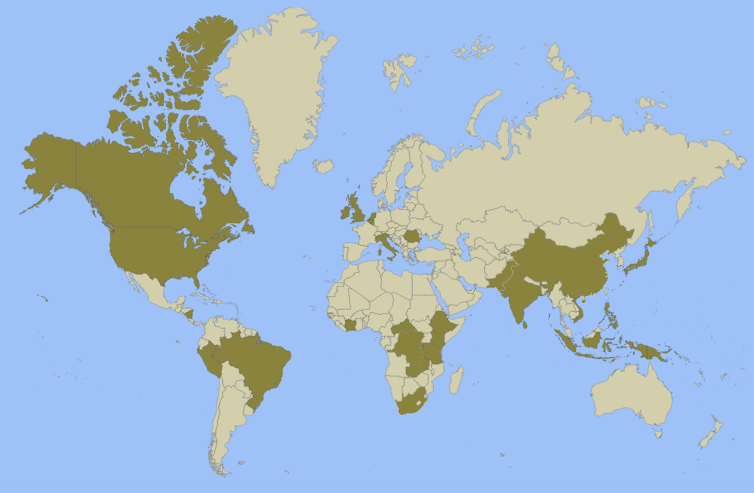
In 1911, the first mission into Central Africa took place. Later on, new houses were established in South Africa, Rwanda, Burundi, Indonesia, Peru, Papua New Guinea, The Philippines, etc. Father Amedeus's successor, Philemon Spapen was superior general from 1922 till 1945. He would stress the importance of the training and the formation of the Brothers. During his period of government, 10 new houses were founded in Belgium and 25 abroad.
Father Warner de Beuckelaer succeeded to him in 1946. He would mostly concentrate on the rebuilding of many houses that had been damaged by W.W. Two. But he was also concerned about the religious life of the Brothers and about recruiting new Brothers. In 1958, Father Conrad Reichgelt took over from him when. At the time there were 1,550 Brothers. It was the Vatican Two period, but he governed with much wisdom and vision. Bro Agnel Degadt was his successor, and Bro Waldebert Devestel was at the helm of the Congregation from 1976 until 2000. He tried to find answers to the new needs and to uphold the spirituality of Canon P.J. Triest among his 750 Brothers and the growing number of lay co-workers in 18 countries. In 2000, Brother René Stockman became the new Superior General. His task will be to guide the congregation into the 21st century.